5 reasons why Stieg Larsson movies are better than the books

Last night I saw The Girl Who Played with Fire (or Flickan som lekte med elden, if you prefer) and was pleasantly surprised to discover that the film was better than the book.

Accepted wisdom says that it’s usually the other way around; the chief exception being movie tie-ins (for a sterling example, see the paperback adaptation of Bram Stoker’s Dracula: A Francis Ford Coppola film, a book-of-the-movie-of-the-book, or a thing that shouldn’t exist). But that just proves the rule of whichever came first is better.

Not in this case. Apart from it taking up much less of my life than the 600-odd page novel, I enjoyed the movie much more. Here are five legitimate reasons why you should too:

  1. In a movie, you’re generally not inside the characters’ heads, subjected to every little thought they have. In this case, that means you don’t have to hear about all their mental peccadilloes, like Blomkvist’s frustration that no one understands his multiple simultaneous love affairs, or Ronald Niedermann’s unfortunate fear of the dark, or Lisbeth Salander solving Fermat’s Last Theorem the proper way (oh yeah, spoiler alert).
  2. You also don’t have to worry about all the dead-end sub-plots that don’t fit into a 2 hour movie – like the inept police investigation, which follows every red herring in an effort to prove Stieg Larsson’s point that men who hate women are bad.
  3. By leaving out those sub-plots, you also don’t have to remember all kinds of near-identical Swedish names (don’t get me wrong, they’re lovely names – sorry, löveljë nämenens).
  4. Similarly, all the locations actually look like interesting places rather than just names from an Ikea catalogue, and all the people have real, distinct identities, instead of the generic Scandinavian faces of my imagination (okay, maybe that’s my lack of effort).
  5. You learn that Paolo Roberto is a real person.

Schrödinger’s parliament – update

Previously, we discussed the indeterminate result of Australia’s federal election and how that left us in a very rare state of macroscopic quantum superposition. Well, I discussed it, and if you did too then you’re probably wondering how far the analogy can be pushed in light of this week’s Oakeshott-Windsor led resolution.

The answer is: just a bit further. Instead of a normal election result, where the quantum system collapses into a classical state either one way or the other, we have a more fragile equilibrium that still has a chance of fluctuating, even if only on individual pieces of legislation. This close-as-you-can-get-to-classical-while-still-being-a-bit-fuzzy-around-the-edges situation is, I declare, a coherent state.

To save me having to go into the details, please read the linked Wikipedia article if you want to find out more. I usually find Wikipedia to be quite good on matters of quantum physics, and this article is no exception. One of its gems is to point out that a coherent state is not the same thing as a Fock state, which is a state with a definite quantum number of particles.

But then again, some would say we really are in a totally focked state.

(Thank you, thank you. It took two blog posts and two weeks of hung parliament to build up the gag, but I think you’ll agree the punchline was worth it.)

Bad scientist

Lex Luthor is clearly a bad scientist. If for no other reason, then the simple mathematical formula of ‘bad guy + mad scientist’. (What? That’s how maths works.)

But he does go to some good sources for his science news. In Action Comics #890, where Action Comics is famously the title that Superman first appeared in, but which Lex Luthor has recently taken over in what could be considered a metatextual response to his failure to conquer either Superman or the Earth, we have the following scene:

Splash page from Action Comics 890

Here, Luthor has plugged himself into his Lexcorp Intelligent Listening Engine, a phenomenally over-engineered virtual reality system that allows him to search for the mention of certain key words on the internet (most of us would just use Google, but then we’re not mad geniuses). He’s seeking news on certain black lantern rings, which appeared in DC Comics’ Blackest Night storyline (don’t bother asking, just read Wikipedia). And yes, he’s wearing bike shorts.

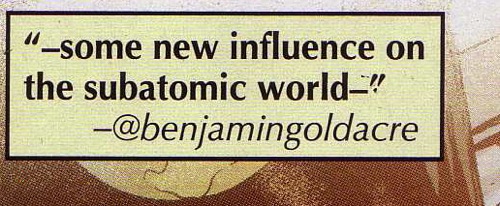
But the important bit is in the lower left of the page, where we see the following caption:

- some new influence on the subatomic world - @benjamingoldacre

That would Dr Benjamin Goldacre, writer of the Guardian column, blog and book, all called Bad Science and all well worth reading. And although his actual Twitter username is @bengoldacre, and his interests are typically more around medical research than subatomic physics, it’s a nice tribute. Where better to go for your sciencey internet needs?

And after all, comic book science is some of the best bad science you’ll find.

Bonus feature: If you want to know what happens in the rest of the comic, check out the live reading from CONvergence 2010. I had no idea they did that sort of thing, but I found it in an internet search. Without, I might add, the aid of any fully-immersive 3D display, and without having to strip down to my underwear. Take that, Lex Luthor.